
McLennan Previous Residents by Era
One McLennan County address can leave records in several places. The current parcel or tax result supplies a starting description, while a recorded deed traces the transfer of an interest in land. Directories, maps, census material, and obituaries add household context that a deed cannot supply. The correct starting source depends on the date. The electronic index is useful for more recent instruments; earlier work needs books, archive material, and microfilm.
| Source | Years It Covers | Where Held | What It Shows |
|---|---|---|---|
| Official Public Records electronic index | 1996 forward | McLennan County Clerk | Recorded party roles, instrument details, and images or index leads. |
| Official Public Records books | 1849–1995 | County Clerk office | Older recorded instruments and the manual deed trail. |
| TSLAC McLennan microfilm | 1850–1906 for direct and reverse deed records | Texas State Library and Archives Commission | Deed, probate, court, marriage, and related historical routes. |
| Waco city directories and local newspapers | Directory runs vary | Baylor and Waco-McLennan Genealogy Center | Dated household, address, and obituary leads. |
For a recent transfer, begin with the current owner and legal description, then search the recorded instrument. For an older McLennan County address, move to the Clerk’s books, the Archives, or TSLAC when the electronic index ends. Directories are a household layer, not a substitute for a deed chain. A dated record role is safer than a claim that a named person lived there.
McLennan Previous Residents Start With a Parcel
The backward trail begins by separating the land description from a person’s mailing details. The McLennan tax portal accepts owner name, property address, account, CAD reference, and fiduciary searches. MCAD’s map search can add the parcel, CAD or PID clue, map location, and legal description. Record the owner, mailing address, situs address, account or CAD reference, legal description, and retrieval date as separate fields.
A situs address describes the land. A mailing address may point elsewhere. A tax owner is not automatically the person occupying the address, and neither result establishes a complete household. The county reports an online tax-roll gap for 2007–2014, so do not bridge that gap by assuming an uninterrupted owner or resident sequence. Ask the tax office, Archives, or appraisal district which year-specific record is available instead.
Note: The legal description is the anchor to preserve when an older street number or rural route no longer matches the present address.
McLennan Previous Residents in OPR
McLennan County’s Official Public Records page says electronic coverage begins January 1, 1996. It also says the office holds records from 1849 through 1995 in book volumes. The two statements describe different access paths. The County Clerk notes retrospective electronic additions for some deeds, deeds of trust, and mechanics liens, but those additions do not make the older record trail complete online.
Official Public Records can include deeds, deeds of trust, liens, releases, transfers, assumed names, assignments, powers of attorney, affidavits, plats, and related instruments. A name can appear as a grantor, grantee, attorney-in-fact, affiant, trustee, lender, or agent. Read the instrument type and party role before treating a name as a lead for previous residents.
Electronic public workstations are available at the Clerk office, 215 N 5th Street, Rooms 223 A&B, Waco, with listed weekday hours of 8–5 and phone 254-757-5078. Bring the party-name variants and any instrument, book, page, account, or CAD reference already found. The Clerk does not provide legal advice, so a request for a record should identify the particular instrument or index rather than ask staff to reconstruct a property history.
| Instrument type | Record whether the item is a deed, deed of trust, release, assignment, power of attorney, affidavit, lien, or plat-related instrument. |
|---|---|
| Instrument and recording dates | Keep execution and recording dates separate. |
| Book, page, or document number | Use the citation to return to the County image or book volume. |
| Legal description | Capture the tract, block and lot, or metes-and-bounds wording instead of relying on a mailing address. |
| Related instruments | Search releases, assignments, and powers of attorney under all named parties. |
Insider tip. The County Clerk says there is no legal-description index. Start with a grantor or grantee, search both name orders and spelling variants, then inspect the instrument and legal description.
Tracing a McLennan County Deed Chain
A chain of title works backward from the present parcel lead. Find the current owner’s acquisition as a grantee, identify the seller in that instrument, then search that seller as a grantee for the earlier acquisition. Recording date, book and page, document number, and legal description hold the chain together when a street form changes. Releases, assignments, powers of attorney, estates, trusts, and liens can branch the trail and must be labeled as their own roles.
- Use the tax portal or MCAD map to save the current owner, situs address, account or CAD reference, and legal description.
- Search the current owner as grantee in Official Public Records and capture the instrument type, recording date, and book, page, or document number.
- Read that deed to identify the grantor, then search the grantor as grantee in an earlier recorded transaction.
- Repeat the dated sequence, checking releases, assignments, and related instruments under every named party.
- When the electronic index stops, use Clerk book volumes, County Archives material, and TSLAC reels rather than guessing at an earlier transfer.
- Grantor
- The party conveying an interest in an instrument. A grantor is not automatically a resident of the parcel.
- Grantee
- The party receiving an interest. The County Clerk’s FAQ says this party name, or a grantor name, is needed to begin the index search.
- Chain of title
- A dated sequence of recorded transfers and related instruments used to trace the property interest backward.
- Legal description
- The tract, block and lot, or metes-and-bounds description that identifies land more reliably than an old mailing or street address.
McLennan Previous Residents Before 1996
Older McLennan County work has a real fallback chain. The Clerk keeps 1849–1995 material in books, while the County Archives holds county clerk indexes, assessor abstract books, tax rolls from 1878–1989, maps, and drawings. TSLAC identifies direct and reverse deed records for 1850–1906 on reels 987569–987572, but notes a gap for filmed index volumes 121–138. Its deed-of-trust records cover 1869–1889, with an index for 1870–1911.
The TSLAC McLennan inventory is the source for reel-level planning.
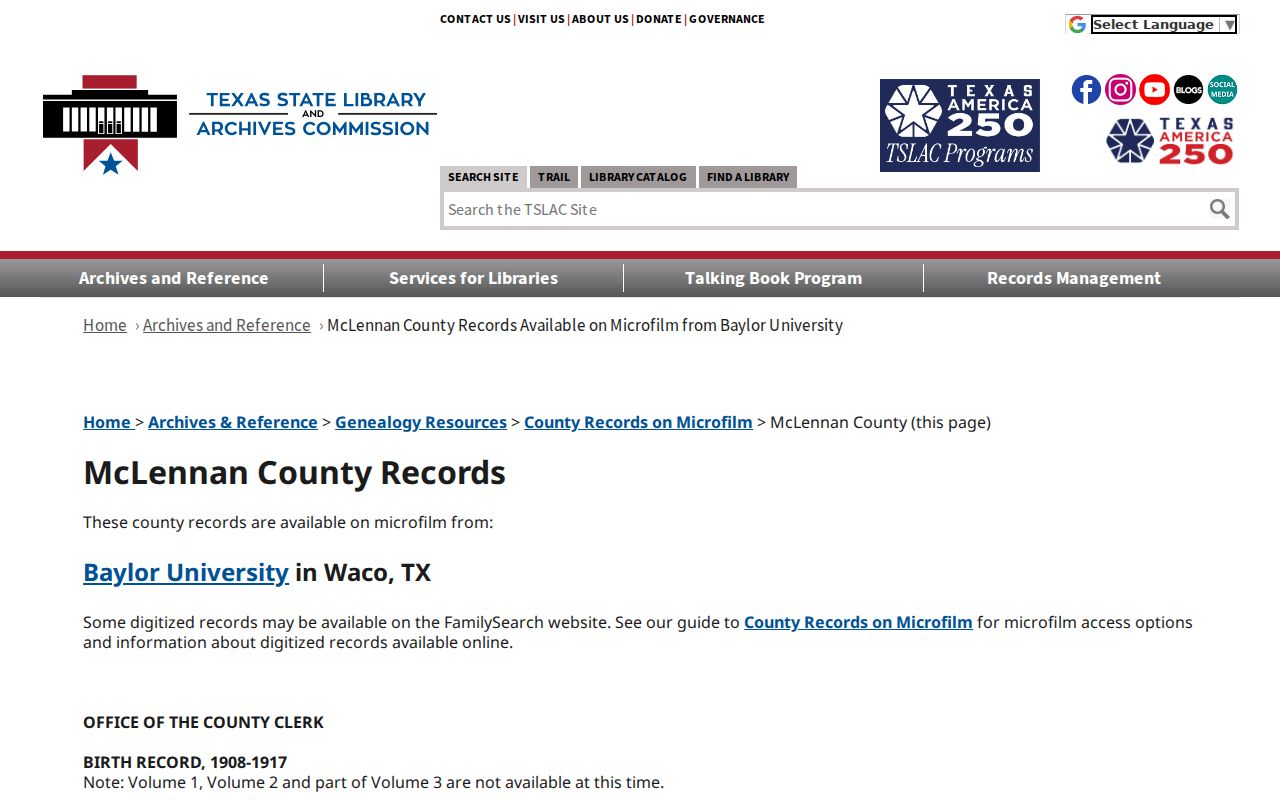
Use a reel, volume, page, image, and repository citation together, because the reel number alone does not identify a household or property transfer.
The McLennan County Archives source documents the local research rooms and their historical holdings.
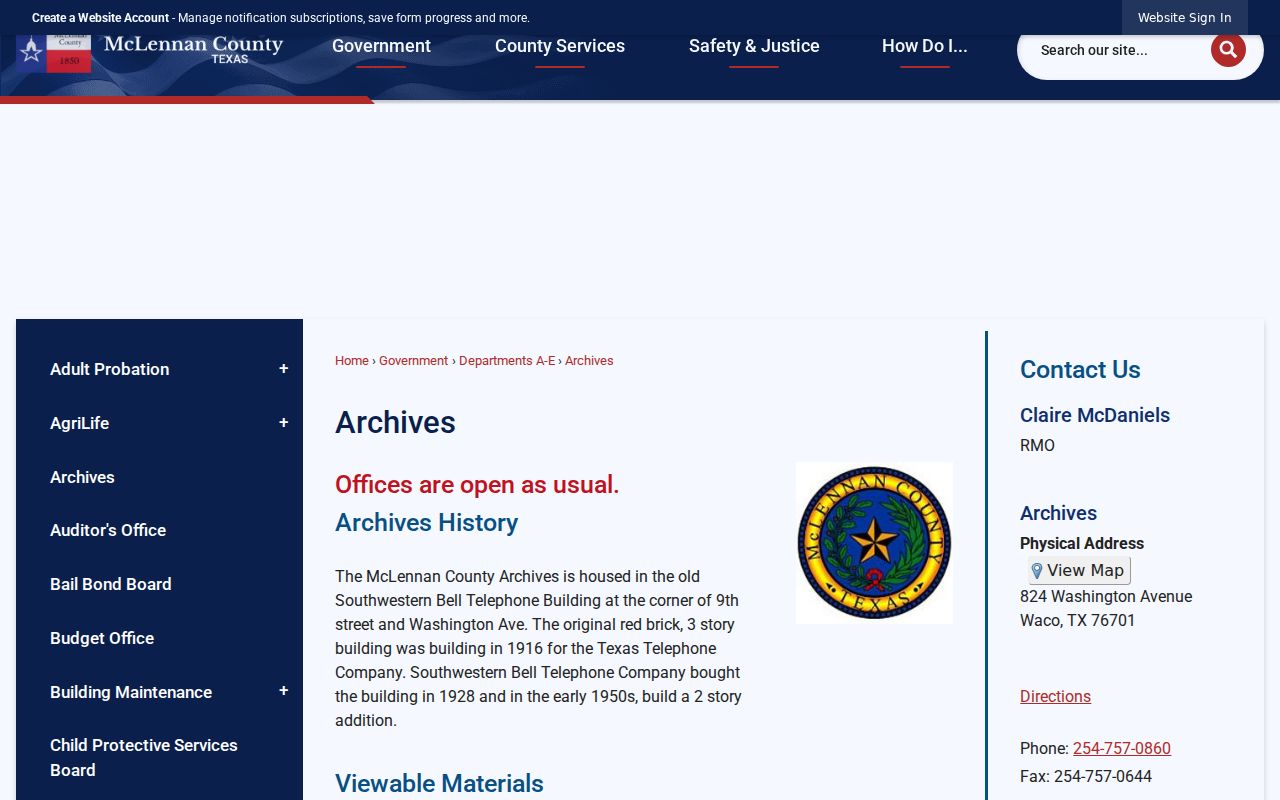
Ask the archivist for the specific record series, year, and index type, and do not assume an archive item has an online name search.
McLennan Addresses Before Rural 911
Rural McLennan County addresses can defeat a name-only or modern-address search. The County Mapping Department describes a joint effort with the McLennan Emergency Assistance District/911 to name rural roads and create physical addresses. An older record may use a route, rural box, landmark, or landowner description where a later tax or GIS record uses a standardized street address.
Crosswalk the older description with a map, deed legal description, and current CAD or parcel ID before connecting it to a person. The County road-map guide and GIS layers can help with geography, but neither proves who lived at the address. This is a reason to preserve each historic address form exactly as printed.
McLennan Past Households in Directories
Ownership is only part of who lived here before. Baylor’s Waco directories cover 1876–1923, and TSLAC has uneven Waco runs from 1878–79 through 1991–94. The Genealogy Center adds local newspapers, census material, family histories, and onsite databases. Use the deed chain to steady the parcel, then use a directory year and the closest available census material to test household names at that address.
The process is: legal description and deed date → directory street form → alphabetic household entry → census material or newspaper lead → obituary, probate, cemetery, or vital-record clue. A disappearance can mean a move, a coverage gap, a spelling change, or a death. It does not answer itself. The historical volumes are described in more detail in the McLennan County city directory collections.
The 1893 Waco Sanborn sheet provides built-place context for a directory address.
The sheet can show the street, lot, building, and land-use setting, but it does not identify a household by itself.
McLennan Previous Residents on Sanborn
Sanborn maps are useful beside a deed chain because they make a historic address visible in time. The Library of Congress has an April 1885 Waco set, and the University of North Texas also identifies Waco 1893 and 1916 sheets. Compare the directory’s street and number with the map date, then test the parcel through a legal description or recorded instrument. A map can support address context, not occupancy.
The 1916 Waco Sanborn sheet is another dated source for that comparison.
Use the image with the directory citation and deed record, rather than letting a building image stand in for a resident record.
McLennan Tax Owners, Not Occupants
Tax and parcel results are valuable for the backward address trail, but they need a plain limit. The county tax search and MCAD map can show owner, mailing address, situs address, account, CAD reference, parcel, and value context. A property owner may have a different mailing address, and an address can have people whose names do not appear as owners. Neither tool is a full list of past residents.
Myth check. A tax-owner result is not automatically the current occupant, and it does not prove a historic household. Compare the dated record role with directory and archive evidence.
McLennan Previous Residents: Lawful Research
Use a past-resident trail for house history, family history, estate questions, or personal curiosity. Keep sensitive details out of notes and distinguish a public instrument from a conclusion about a living person. Texas public-information rules apply to existing records and may involve redaction, fees, or a written request to the correct custodian.
The Texas Attorney General’s request guidance says a request should be in writing and directed to the governmental body. It seeks existing information; the agency generally does not have to answer a question, create a document, or conduct research in a requested format. Name the record series, date range, and identifiers already found.
Lawful use. Do not use a McLennan County previous-resident search to stalk, harass, or track anyone. Preserve only the dated record details needed for a personal historical question.